Best Betting Sites
»
Best Prediction Market Sites for Trading Event Contracts
»
What Is a Prediction Market and How It Works
»
How to Read Market Prices as Probabilities
How to Read Market Prices as Probabilities
By
James Thompson,
Last Updated on 18.09.2026
When first getting involved with prediction markets, getting to grips with how to read market prices can be a demanding task. Behind these prices is a simple idea, but it pays to be rigorous in learning how they reflect probabilities.
Once you have grasped what the numbers mean, you begin to see prediction markets less as an abstract system and more as tools for interpreting belief and evidence. Whether you’re into stats, curious about potential outcomes, or just interested in trying out prediction markets, learning how pricing works gives you a much clearer picture.
Best Sweeps Casino Promo
Compare the Top Prediction Market Sites in September

Table of Contents
- What a market price actually represents
- Prediction market pricing pros and cons
- Why prices sit between $0 and $1
- Popular prediction market platforms
- How you profit from market prices
- Prices and probability in practice
- A quick note on legality
- Learn More About Prediction Markets Through Our Detailed Guides
- Conclusion: Prediction market prices are easy when you know the facts
- How to read market prices FAQ
What a market price actually represents
At the core of prediction markets pricing is a simple concept: price reflects probability.
If a contract is trading at:
- $0.20 - this implies a 20% probability, so a low but not non-existent chance
- $0.50 - this means a 50-50 chance; it literally could go either way
- $0.80 - this reflects an 80% chance - highly likely, but not a foregone conclusion
Until they resolve, contracts will never be priced at $0 or $1 - because these are binary outcomes; a thing has happened or definitively hasn’t. And probability is not infallible. We’ve all seen 99% chances that didn’t come off, or 1% chances that happened. These numbers are a real-time reflection of what participants believe based on the information available to them at the time. So you should be asking:
- Is this probability accurate?
- Do I think it should be higher, or lower?
Prediction market pricing pros and cons
Pros and Cons
- Easy to understand
- Calculating profit is simple
- A solid gauge of probability
- Driven by real-time information
- Can move dramatically and suddenly
Why prices sit between $0 and $1
Prediction markets are designed to settle in a binary way. They pay out:
- $1 if the outcome happens
- $0 if it doesn’t
Because of this, prices fall between these two ends of the spectrum. A 0% possibility of something happening means it is already impossible for it to happen - for example, a player will not be selected for their country’s World Cup squad because it has already been announced and their name isn’t down. A 100% chance means it has already happened. And so if you said Yes, that player will be at the World Cup, you get nothing if they aren’t there, and $1 if they are.
If you bought the contract (said Yes) that they would be there at $0.65, and they do get selected, you get $1, so that’s a $0.35 profit. If they don’t, you lose your 65 cents. Once you understand this framework, you understand market pricing.
| Market Price | Implied Probability | Meaning |
| $0.10 | 10% | Highly unlikely |
| $0.30 | 30% | Possible, but unexpected |
| $0.50 | 50% | Even chance |
| $0.70 | 70% | Probable |
| $0.90 | 90% | Extremely likely |
Popular prediction market platforms
Understanding market prices is only part of the equation. The platform you choose also plays an important role, as different prediction markets vary in liquidity, market coverage, payment methods, and trading tools. Some focus heavily on crypto-powered markets, while others provide regulated event contracts through more traditional financial platforms.
Below are two of the most popular prediction market platforms for reading and trading market probabilities:
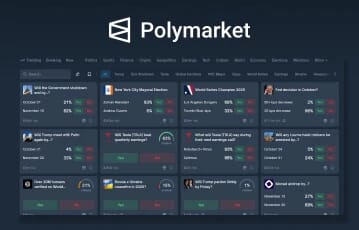
Polymarket - Best for deep and active prediction markets

Polymarket: Pros and Cons
- Provides hundreds of event contracts
- Features an Android and iOS app
- Supports multiple cryptocurrencies
- Services are limited in the US
Polymarket is one of the largest prediction market platforms available, making it an excellent place to see how market prices reflect probability in real time. Thousands of active markets cover everything from sports and politics to economics, crypto, and global events, giving you plenty of opportunities to compare probabilities across different topics.
The platform uses cryptocurrency payments, supporting Ethereum and Polygon, while verified users can also fund their accounts with Visa and Mastercard. One feature we particularly like is the platform's liquidity, which makes it much easier to enter and exit positions before markets settle. Combined with responsive mobile apps on both iOS and Android, Polymarket offers one of the smoothest environments for learning how prediction market pricing works in practice.
Robinhood - Best for beginners learning prediction markets


Robinhood: Pros and Cons
- Free stocks welcome bonus
- Available downloadable app
- Coverage of over 1600 events
- Limited climate markets
Robinhood offers a simple way to understand prediction market pricing without leaving a familiar investing platform. Through its partnership with Kalshi, users can trade event contracts covering sports, politics, economics, and other real-world events while using the same interface they may already know from stock and ETF investing.
Funding your account is straightforward with ACH transfers, instant bank transfers, and debit cards, and buying or selling contracts feels much like placing any other investment order. Although Robinhood doesn't provide dedicated prediction market bonuses, eligible new users can receive free stock through its welcome offer, alongside referral rewards and Robinhood Gold benefits. If you're new to prediction markets and want an easy introduction to reading probabilities, Robinhood is one of the most accessible places to begin.
How you profit from market prices
There are two main ways that participants in prediction markets generate returns.
Holding until resolution
In this approach, you buy a contract at below $1. If you are correct, the market settles at $1 and your profit is the difference between the buying price and $1, as outlined above.
Exiting before resolution
You can profit before the resolution of a contract. In this case, you buy at below $1. Let’s say the price was $0.45. Then it rises as more information becomes available. The price goes as high as $0.70, and you’re thinking “I’m pretty confident in this thing happening, but I’m not 70% confident.”.
At this stage, you can sell for $0.70, so you would then profit $0.25 on that trade. Your profit is locked in - if the outcome then does come to pass, you could have profited by more, but if it doesn’t, you’ve made 70 cents that would otherwise have been zero.
Prices and probability in practice
Let’s take a practical example. Imagine a market asking “will a certain cryptocurrency hit a certain price this month?” If the contract trades at $0.40, the market is saying there’s a 40% chance this will happen. If you follow crypto closely, you might:
- Compare that to volatility trends
- Consider upcoming announcements and watch news events
- Evaluate momentum
This is where crypto prediction markets become intuitive for users already familiar with price speculation. You are leveraging your own knowledge to make a probability judgment. If you believe there is a better than 40% chance that the cryptocurrency will hit that price point, your move will be to buy the contract either to hold until resolution, or watch as the market shifts and the price rises - hopefully to a point where you can trade out and realize a solid profit.
A quick note on legality
You may be wondering in among all of this: Are prediction markets legal where I live? And right now, the answer is most likely yes - but things are never that simple, so let’s drill down.
Right now, prediction markets are treated as a financial trading instrument, which means they are regulated under the Commodity Futures Trading Commission (CFTC). There is no immediate reason to think this will change in the short term, but it would be rash and simply untrue to say that we could speak for what will happen in coming years. Some lawmakers are minded to change this status but at present, there’s not a definitive groundswell that makes it likely any time soon. For now, with standard fees and other costs of event trading, the picture is clear: prediction markets are legal. We’ll be sure to update this information if there are any changes, of course.
Learn More About Prediction Markets Through Our Detailed Guides
Need more context before comparing prediction market sites? The prediction market guides below explain how they work, how event contracts are structured, how to read market prices, and how major platforms compare. Use them to understand the basics before choosing where to trade.
| Prediction Market Guides | Check the Guide Here |
|---|---|
| What Is a Prediction Market | What Is a Prediction Market and How It Works |
| Prediction Markets in the US? | Are Prediction Markets Legal in the US? |
| Kalshi vs Polymarket | Kalshi vs Polymarket: Which Prediction Market Is Best For You |
| Kalshi vs Robinhood | Kalshi vs Robinhood: Which Prediction Market Is Best For You |
| Event Contracts | What Are Event Contracts and How They Work |
| Prediction Markets vs Sportsbooks | Prediction Markets vs Sportsbooks: Differences Explained |
| How to Read Market Prices | How to Read Market Prices as Probabilities |
| The Hidden Costs of Event Trading | The Hidden Costs of Event Trading Explained |
Conclusion: Prediction market prices are easy when you know the facts
It’s sensible to be cautious when it comes to knowing how to read market prices. Financial risk is a real thing and you want to be sure of yourself before you ever place a single trade. But as long as you view prediction markets as a scale from 0 to 1, and are able to understand what the numbers in between equate to in terms of probability, you’re not going to go too far wrong. Knowing this - and also being alive to the possibility that you can react to price changes in real time - will serve you well. And if you want to get started, all of our banners are here for you to check out the best sites.