
Best Betting Sites
»
Robinhood Review
»
Robinhood Event Contracts Explained
Robinhood Event Contracts Explained: Trading and Settlement
By
James Thompson,
Last Updated on 15.09.2026
We went through Robinhood's prediction markets hub over the past couple of weeks, tested their event contracts across a range of different categories, and looked around every single corner of the site to figure out how it works.
Robinhood event contracts are Robinhood's take on prediction markets, and they've been gaining a lot of traction this year for going well beyond just election markets. Here, we're going to cover how the contracts work, what you can trade on, how fees play out, and where things stand with the legal and regulatory mess hanging over everything.
Table of Contents
- What are Robinhood event contracts?
- Pros and cons of Robinhood event contracts
- How prediction markets work
- Where Robinhood fits in
- What you can trade on
- Fees, order types, and how to trade
- What makes Robinhood event contracts different from other derivatives
- The regulatory fight over prediction markets
- Prediction markets are the next big thing
- Robinhood event contracts FAQ's
What are Robinhood event contracts?
As mentioned in our Robinhood prediction markets review, a Robinhood event contract is a binary question about something that either will or won't happen by a certain date. You pick Yes if you think it happens, No if you think it doesn't, and each side is a separate contract you're buying. When the event date comes, the contract resolves to $1 if you called it right and $0 if you got it wrong. There's nothing in between.
Pros and cons of Robinhood event contracts
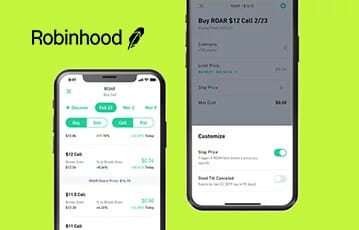
Pros and Cons
- Low cost per contract with only $0.01 commission
- You can't lose more than your position
- Covers 11 categories including politics, climate and crypto
- App-only with no web trading option right now
How prediction markets work
Pricing is probably the part that confuses newcomers the most and it all revolves around implied probability.
Pricing and what the numbers mean
Contract prices run from $0.01 to $0.99 and each cent maps roughly to a one percent implied probability, so a contract at $0.53 means the market is pricing in about a 53% chance. Robinhood does note that some contracts have an extra $0.01 worked into the pricing which means Yes and No sides can theoretically add up to 101%.
Settlement and getting out early
You can ride a contract all the way to settlement and collect $1 or $0, but you can also close the position earlier if the price moves your way and you want to lock in a return. Some of these contracts run for months which gives you a decent window to work with. We liked having the flexibility to take profit early on the longer-dated ones rather than just sitting and waiting.
| Feature | Details |
| Contract type | Yes/No binary event contracts |
| Price range | $0.01 to $0.99 |
| Settlement | $1 if correct, $0 if wrong |
| Commission | $0.01 per contract per side |
| Categories | 11 including politics, sports, economics, crypto |
Where Robinhood fits in
There are a few other key points to understand before getting started with Robinhood event contracts.
📈 Robinhood is the broker not the exchange
Robinhood is just the retail-facing brokerage app on your phone. The exchange and clearing infrastructure lives underneath and is handled by separate entities. Contracts go through KalshiEX LLC or ForecastEX LLC and both have been through the full CFTC approval process.
⚖️ Why the CFTC approval is a big deal
What separates Robinhood event contracts from offshore prediction sites is that CFTC oversight means compliance requirements around clearing, reporting and market integrity. That gives you a regulatory structure most others can't offer.
💼 What it means on a practical level
Your contracts get cleared through a regulated intermediary, your funds sit in a defined structure, and the exchange has rigid reporting obligations. None of that removes market risk, and we want to be upfront about that, but it puts Robinhood in a different category than a crypto prediction site running out of an offshore jurisdiction with minimal oversight.
What you can trade on
The range of categories has expanded fast since Robinhood launched the prediction-markets hub in March 2025, and some of them might surprise you.
Economic and political markets
The main categories include politics, economics, financials, crypto, climate, companies, tech and science, health, and world events. We spent the most time in the economics category because you can trade on things like rate decisions and macro events without needing a futures account. That opens up a whole side of the market that retail traders couldn't really access before.
Sports and culture
Robinhood sports contracts are the controversial part of the site and we'll get into why later. But they have pro football contracts including game outcomes, spreads, totals, player props like anytime TD and passing yards. They've also added preset combos where you combine multiple outcomes from a single game into one contract. The culture side has markets like who will headline Lollapalooza, which is a different vibe from the rest of the hub but it's there.
Fees, order types, and how to trade
Fees look tiny on paper, but you still need to keep an eye on what it’s costing you per contract.
Commission and exchange fees
You pay $0.01 per event contract per side and the exchange may charge another $0.01 on top, but some contracts fold that extra cent into the pricing instead. Robinhood fees are low overall, and the main thing to keep in mind is that on a $1.00 position even a couple of cents represents a bigger percentage of your return than it would on a regular stock trade.
App-only access
Everything is app-only right now. The app is great and we had no problems with it during testing, but a bigger screen would be nice for keeping tabs on multiple contracts. Robinhood's regular stock trading works on desktop, so we'd love to see event contracts make it there too.
Predict economic markets at Robinhood
Access Robinhood events contracts on the go
What makes Robinhood event contracts different from other derivatives
Event contracts work differently from futures or options, and we think the differences are a big part of why it appeals to people who haven't traded derivatives before.
💰 Full Collateralization and No Margin
Robinhood's disclosures say event contracts are fully collateralized, can't be bought on margin, and never require additional funds to maintain a position. You put your money in, and that's the most you can lose on any single contract. There's no margin call scenario, which we think is one of the biggest draws.
📊 A Format That Clicks for Retail Traders
Event contracts strip out all the complexity you get with traditional derivatives. There's no strike prices, greeks or expiration curves to think about because you're just picking yes or no on a real-world outcome. We think that's the other big draw because you don't need any derivatives knowledge to understand what you're doing.
The regulatory fight over prediction markets
Now for the complicated part, and it's the reason Robinhood event contracts are as controversial as they are popular right now.
Federal scrutiny and state pushback
In its 2026 10-K, Robinhood disclosed that the company faced scrutiny tied to Robinhood election and sports-related contracts, including a February 2025 CFTC request that led them to suspend a pro football championship market.
How the CFTC's position keeps shifting
After withdrawing its 2024 event-contract rule proposal, the CFTC launched a new advance notice of proposed rulemaking in March 2026 asking for public comment on prediction markets, including how to treat contracts involving "gaming." The framework is still being written and nobody knows what the outcome will be.
What that uncertainty means going forward
Prediction markets are growing quickly but its long-term operating boundaries are being fought over in courts at both the federal and state level. Categories that exist today could get pulled tomorrow if a ruling goes the wrong way, so every trader using this needs that in the back of their mind.
Prediction markets are the next big thing
Robinhood event contracts are well put together, and the CFTC-regulated exchanges underneath give it a level of credibility you won't find with most alternatives. The regulatory side is still being worked out, and that's the one thing to stay aware of, but the product itself is a popular choice right now.
If you want to get started, click the banners on this page to sign up to Robinhood and try event contracts for yourself.
