
Best Betting Sites
»
Robinhood Review
»
Robinhood Sports Markets Explained
Robinhood Sports Markets Explained: Sports Event Contracts
By
James Thompson,
Last Updated on 17.09.2026
Sports enthusiasts love everything about their team, from watching the team on TV to attending live events to wearing the merch. Some sports fans even predict Robinhood sports event contracts.
While these sports predictions sound like sportsbetting, they’re not the same. These predictions happen on the Robinhood trading platform, which is regulated by the federal government. Traders purchase event contracts based on their predictions, such as who will win a game. If you think you can make some good sports predictions, then you’re going to want to keep reading…
Table of Contents
- What is prediction betting at Robinhood?
- How does a trader make a profit with a Robinhood sports contract?
- Can a trader exit a Robinhood sports contract early?
- What sports markets does Robinhood list?
- How do you sign up and start buying Robinhood sports event contracts?
- Pros and cons of participating in Robinhood sports prediction markets
- Final thoughts on Robinhood sports prediction contracts
- Robinhood sports FAQs
What is prediction betting at Robinhood?
Predicting the outcomes of sporting events at Robinhood is a bit different than placing wagers through a traditional sportsbook, but it is similar to Kalshi sports event contracts. Traders at Robinhood buy contracts based on what they predict as the outcome of an event, which often takes the form of a binary outcome.
For example, the prediction might take the form of a question such as, “Who will win the tip off at the basketball game – Los Angeles Lakers or Denver Nuggets?” Here’s an example of what the two contracts may look like:
- Denver wins the tipoff: 60¢
- Los Angeles wins the tipoff: 40¢
The trader then purchases the contract based on their predicted outcome. For example, if the trader thinks LA will win, they buy their desired number of contracts for 40¢ each. The contract value can be viewed as the probability an event will occur according to the market. In this example, traders think there’s a 40% chance the LA wins the tipoff. Note that the total of all outcomes will always add up to $1.
Here’s an overview of the other difference between Robinhood sports predictions and sports betting:
| Feature | Robinhood | Traditional sportsbook |
|---|---|---|
| Regulated | Yes, by the CFTC | Licensing varies |
| Legal for U.S. residents | Yes, though some states are contesting it | Not legal in all states |
| Multiple sports listed | Yes, 10+ major sports | Yes, varies |
| Esports | Yes | Yes, usually |
| Prediction or betting | Predictions | Sports betting |
| Ability to exit a contract early | Yes | No |
| Payout | Fixed at $1 | Varies based on odds |
How does a trader make a profit with a Robinhood sports contract?
If the trader gets their prediction wrong, they’ll get $0 since this is an “all or nothing” proposition. If the trader correctly predicted the outcome, they’ll get $1 per contact they purchased. Their profit is then $1 - [the amount they purchased their contract for].
Let’s go back to our previous example where the trader purchased the contracts for 40¢ saying LA would win the tipoff. If the trader is right, he’d make a profit of 60¢ per contract, minus the required Robinhood fees. If the trader originally purchased 100 contracts predicting this outcome, then he’d make a profit of $60 for this event (minus fees).
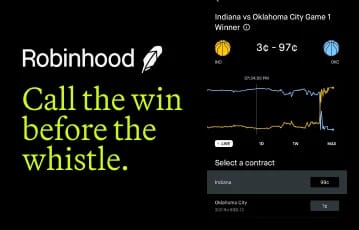
Make your call on sport events with Robinhood.
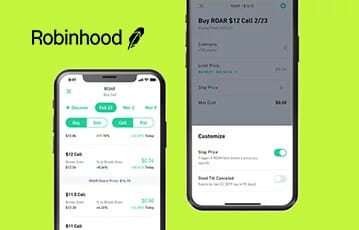
Predict Robinhood sport markets on your device
Can a trader exit a Robinhood sports contract early?
Yes, traders don’t need to wait for the final outcome of the sporting event, and they can exit the contract any time. Traders can do this for any reason, but common reasons include:
- Locking in a profit as the market moves
- Mitigating losses
- Pulling money out of a contract to move to a different market
For example, let’s suppose a trader purchased an event contract at 25¢, and the market moved so that contract is now worth 75¢. The trader can sell the contract and make a profit of 50¢, which is the difference between their buy and sell price.
Another example – perhaps the trader purchased a contract at 60¢, and the price for the contract has dropped to 50¢. The trader may exit the contract early to mitigate potential losses. In this case, he’d lose 10¢ per contract, but perhaps selling now would protect him from losing even more money.
Take note that exiting a contract early incurs the usual trading fees of $0.02 per contract.
What sports markets does Robinhood list?
Here are the main categories of sports that this platform offers:
- Baseball
- Boxing
- College baseball
- College basketball
- Cricket
- Golf
- MMA
- Pro basketball
- Pro football
- Pro hockey
- Racing
- Soccer
- Tennis
- eSports
Within each of these categories you’ll often find dozens of events. These event contracts include popular predictions such as who will win an event. The contracts also include many other markets such as who will score points first, who will get a penalty first, and so on. There are also markets not tied to games, such as which coach will retire first, which team will a player join next, and similar types of questions.
Note that the more popular a particular sporting event is, the more likely it is that you will see plenty of “extra” markets. For instance, the Super Bowl will provide opportunities to predict quite a few events, whereas a college baseball game that doesn’t draw much interest may only have one event contract (who will win), or a few at most.
How do you sign up and start buying Robinhood sports event contracts?
You can get started by following these steps:
-
Tap the Robinhood banner on this page
The banner on this page will also tell you if there are any offers currently available to new users. Also, note that Robinhood is a “mobile first” platform, so you can download and use the app for your trades, or you can use a desktop or laptop.
-
Create your account
You’ll need to provide the platform with your personal information such as your full name, postal address, contact information, and your social security number. Note that the social security number is required for tax purposes, as well as identity verification.
-
Verify your identity
Next, you will need to prove you are who you say you are by uploading your official government-issued identification, such as a driver’s license or a passport, plus you’ll need to take a selfie.
It’s important to note here that residents of some states may be unable to purchase sports event contracts, including those people living in New Jersey, Nevada, and Maryland.
-
Connect your funding
Next, you’ll be asked to connect a source of funding, such as your credit card, debit card, or bank account.
-
Apply for derivatives trading
You’ll need to have a derivatives trading account on Robinhood to trade event contracts, and to get this account you’ll need to apply for it. Regulatory compliance requires Robinhood to ask you certain questions about your experience, plus they want to ensure that you understand the risks involved in this type of trading. Accounts usually get approved fairly quickly, within a few minutes to a few hours.
-
Find an event
Once you get approved for derivatives trading, then you can head over to the “Events Contracts" hub. You can browse the sports categories, or you can even search for a specific game or event. Click on an event that interests you, and analyze the price and consider your prediction.
-
Place your trade
Now you can choose your position, and purchase the desired number of contracts based on your predicted outcome. You can choose the specific number of contracts you’d like to purchase (such as 200), or you can specify the total dollar amount (e.g., $300 worth of contracts). You’ll then be asked to review the 2¢ fee per contract, confirm your selection, and finalize your trade.
-
Manage your contracts
You have options. You can hold the contract and simply wait until the event ends and your contract expires. On the other hand, you can exit or sell your contracts early to lock in a profit or mitigate losses before an event ends.
If you are right about your prediction, Robinhood will pay you $1 for each contract you purchased with the correct outcome. If you are wrong, you get $0 (and you lose the money you used to purchase the contracts).
Pros and cons of participating in Robinhood sports prediction markets
Robinhood’s sports prediction markets let you trade on real-world sports outcomes in a pretty straightforward way, but like anything involving trading, there are upsides and downsides. Here’s a quick breakdown:

Pros and Cons
- Legal in most states and regulated by the CFTC
- Broad range of sports and esports for enthusiasts
- Traders can exit their contracts early
- Traders can lose money on their event contracts
Final thoughts on Robinhood sports prediction contracts
Purchasing sports event contracts is a great way to add a little extra entertainment to your favorite sporting events. One advantage is that Robinhood sports trading is available to most people living in the United States, with the current exception of people living in MD, NJ, and NV, though these restrictions may change. Another benefit of using Robinhood for these trades is that it’s regulated by the federal government, so you can have peace of mind as you make your predictions and purchase your contracts.
To get started trading, just tap the Robinhood banner on this page, which will enable you to take advantage of any sign up bonus that’s available to you.
